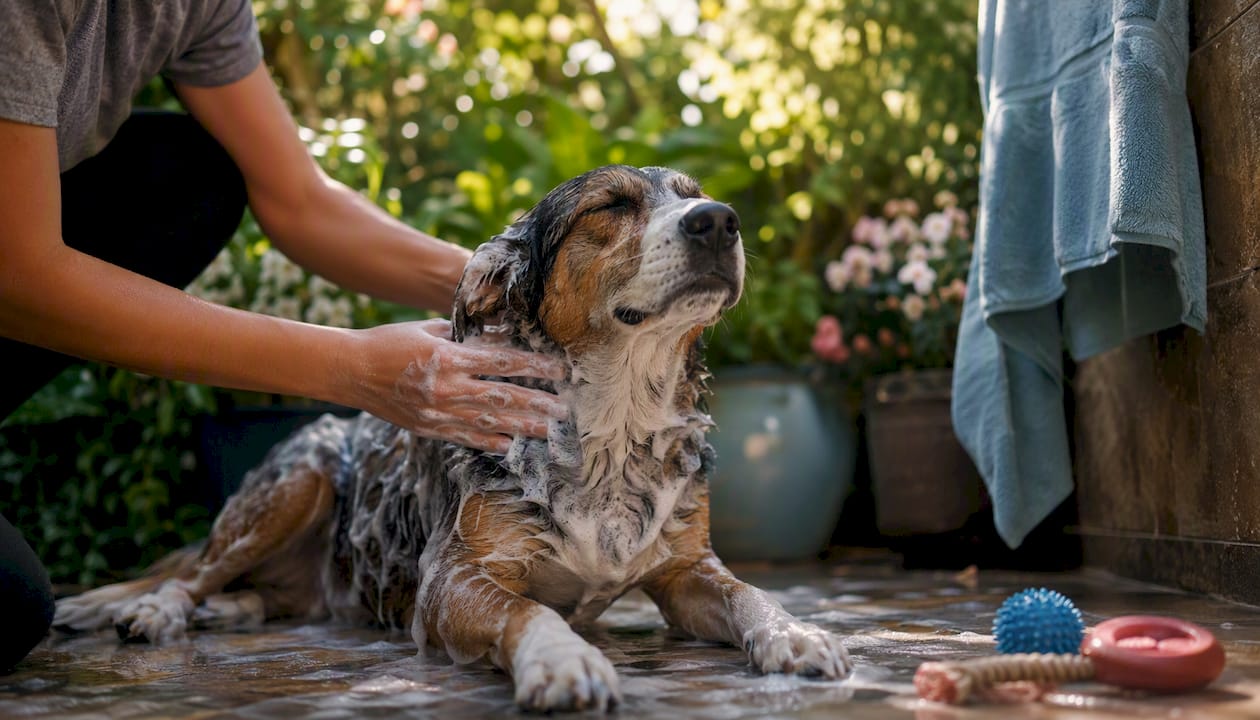
A flea bath kills adult fleas on contact and gives your dog fast, visible relief — but it provides little residual protection, so reinfestation can happen within a day if you don’t address the environment. Think of it as step one of a coordinated plan, not the whole solution.
Start here:
- Emergency contact-kill: A small amount of Dawn dish soap lathered into the coat and left for five minutes will suffocate adult fleas. This is a short-term measure, not a treatment plan.
- Rapid systemic kill: Capstar (nitenpyram) is an over-the-counter oral tablet that begins killing adult fleas within 30 minutes and is safe for dogs and puppies over four weeks and 2 lbs. Use it alongside a bath for faster relief.
- Isolate your dog’s bedding immediately, wash it in hot water, and vacuum the rooms your dog frequents before bringing them back in.
Pro Tip: If your dog is a puppy, a senior, pregnant, or shows signs of skin irritation, monitor closely after any flea product application and contact your veterinarian before using medicated shampoos.
Key Takeaways
A flea bath kills adult fleas on contact but must be paired with a systemic preventive and coordinated home treatment to stop reinfestation and break the flea life cycle.
| Point | Details |
|---|---|
| Baths give fast relief, not lasting protection | Adult fleas die on contact, but reinfestation can happen within hours without follow-up treatment. |
| Environmental stages extend control to 2–3 months | Eggs, larvae, and pupae in the home continue emerging long after the dog is treated. |
| Treat all pets and the home simultaneously | Every pet in the household needs treatment; home IGR and adulticide application must start the same day. |
| Puppies, seniors, and allergic dogs need vet guidance | These groups face higher risks from both fleas and flea products; a veterinarian should direct their treatment plan. |
| The Pampered Pup supports recovery after flea episodes | Our cage-free de-shedding treatments, deep conditioning baths, and gentle handling help restore skin and coat comfort. |
Table of Contents
- How effective is a flea bath, and what are its real limits?
- What should you use for a safe, effective flea bath?
- How to give your dog a flea bath at home, step by step
- What follow-up treatments does your dog need after a bath?
- How to treat your home and yard so fleas don’t return
- When should you call a veterinarian about fleas?
- What we see at The Pampered Pup: a groomer’s perspective on flea baths
- The part of flea control most people get wrong
- Gentle, professional flea care at The Pampered Pup
- Sources
- FAQ
How effective is a flea bath, and what are its real limits?
A flea bath works by direct contact. When a flea shampoo or dish soap coats the flea’s body, it disrupts the insect’s nervous system or blocks its breathing, killing adult fleas present on the dog at that moment. Follow the contact time listed on the product label — usually five to ten minutes — and you will see results.
The limits are significant, though. Flea shampoos provide little residual protection; a dog can walk back into a flea-infested room and pick up new adults within hours. Shampoos also have no effect on flea eggs, larvae, or pupae already in the environment.
The flea life cycle is the reason infestations feel so stubborn. Fleas pass through four stages: egg, larva, pupa, and adult. Only the adult stage lives on your dog. The other three stages live in carpets, bedding, and yard debris — and they are not touched by a bath.
- Eggs fall off the dog into the environment within hours of being laid.
- Larvae burrow into carpet fibers and feed on flea dirt.
- Pupae spin protective cocoons that are resistant to insecticides and can remain dormant for months, emerging only when they sense heat and vibration from a passing host.
- Adults jump onto your dog, feed, and begin laying eggs within 24–48 hours.
Control often takes several months even when pet and home treatments are applied correctly, because environmental stages continue emerging long after the adults on your dog are gone.
Bathing relieves itching and reduces the adult flea load quickly. Paired with systemic preventives and home treatment, it is genuinely useful. Alone, it is temporary.
What should you use for a safe, effective flea bath?
Medicated flea shampoos
Purpose-formulated dog flea shampoos contain adulticide ingredients such as pyrethrin or permethrin. They kill on contact and are widely available without a prescription. Always read the label for age, weight, and species restrictions before applying.
Critical safety warning: Permethrin is highly toxic to cats. If you have cats in the home, keep them away from any treated dog until the coat is completely dry, and choose a permethrin-free product if cross-contact is a risk.
Dawn dish soap as an emergency option
Original blue Dawn is a common emergency contact-kill option. It works by stripping the waxy coating from a flea’s exoskeleton. It is gentle enough for most dogs and puppies when used sparingly, but it can dry out the skin and coat with repeated use. Reserve it for true emergencies, not for routine flea control.
Follow-up products to discuss with your vet
A bath alone will not prevent reinfestation. These are the products most commonly recommended for follow-up:
- Capstar (nitenpyram): An OTC oral tablet. Kills adult fleas rapidly, within 30 minutes of ingestion. Duration is short (24 hours), so it pairs well with a bath for immediate relief while you start a longer-term preventive.
- Advantage (imidacloprid): A topical spot-on applied to the skin. Kills adult fleas on contact with the coat; OTC in most formulations.
- Frontline (fipronil): A topical spot-on that kills adult fleas and ticks. Available OTC.
- Bravecto (fluralaner): An isoxazoline available as a chewable tablet or topical. Provides up to 12 weeks of protection. Requires a veterinary prescription.
- NexGard (afoxolaner): An isoxazoline chewable tablet, monthly dosing. Prescription required.
Wait before applying a spot-on: Most topical products require 24–48 hours after bathing before application so the natural skin oils that help distribute the product have time to replenish. Check your specific product label.
Medicated shampoos kill adult fleas on contact but do not provide lasting protection; combining a bath with a systemic preventive gives you fast relief plus persistent control.
Puppy and senior caution: Many flea shampoos carry minimum age and weight requirements. For puppies under 12 weeks or dogs with compromised health, consult your veterinarian before using any medicated product.
How to give your dog a flea bath at home, step by step
Before you start
Gather everything first: flea shampoo or Dawn, a flea comb, towels, a non-slip mat for the tub, and treats. Move your dog’s bedding and toys out of the bathing area. If you have cats, secure them in a separate room.
The bathing procedure
- Pre-soak the coat with lukewarm water from neck to tail. Lukewarm is key — hot water stresses the dog and opens pores unnecessarily; cold water makes the experience unpleasant and reduces lathering.
- Create a soap barrier at the neck first. Apply a ring of shampoo or dish soap around the neck before wetting the rest of the body. This prevents fleas from migrating to the face as you work downward.
- Lather from neck to tail, working the product into the coat down to the skin. Pay close attention to the groin, armpits, base of the tail, and between the toes — fleas congregate in warm, sheltered spots.
- Let the product sit for the full contact time listed on the label — typically five to ten minutes. Use this time to run a flea comb through the coat while the product is still on. Focus on the neck, face, and base of the tail.
- Rinse the flea comb into a bowl of soapy water after each pass to trap and drown the fleas you remove.
- Rinse thoroughly from head to tail with lukewarm water until the water runs clear. Residue left in the coat can irritate skin.
- Repeat only if the label explicitly allows it. Over-shampooing strips the coat and can cause dryness, especially in Gulf Coast humidity where skin is already working hard.
Pro Tip: Keep a wiggly dog calm by pausing every minute or two for a small treat and a quiet word of praise. Short breaks reduce stress and make the next bath easier — a dog who associates bathing with calm and reward is a dog who cooperates.
After the bath
- Towel-dry gently, then use a low-heat blow dryer if your dog tolerates it. In Mobile’s humidity, a damp coat can stay wet for hours and invite skin irritation, particularly in thick-coated or double-coated breeds.
- Do a final flea comb session over the tub or sink so any remaining fleas fall into the drain.
- Wash all bedding in hot water immediately.
- Vacuum carpets, furniture, and baseboards before your dog re-enters those spaces.
- Note the time and date — this is when your systemic preventive clock starts.
What follow-up treatments does your dog need after a bath?
A bath reduces the adult flea burden quickly, but it does not protect your dog from the fleas still developing in your home. Systemic products such as isoxazolines and nitenpyram can kill the majority of fleas rapidly and are a central part of eliminating infestations — even so, environmental stages can extend full control to 2–3 months.
Immediate relief: Capstar (nitenpyram)
Capstar begins working within 30 minutes and kills adult fleas for approximately 24 hours. It is available OTC and is safe for dogs and puppies over four weeks and 2 lbs. It is not a preventive — it clears the current adult load while you arrange longer-term protection.
Longer-term prevention: isoxazolines
Bravecto (fluralaner) and NexGard (afoxolaner) belong to the isoxazoline class, which works by blocking flea nerve receptors. Both require a veterinary prescription.
- Bravecto: one chewable dose protects for up to 12 weeks.
- NexGard: monthly chewable, also effective against ticks.
Year-round flea preventives are recommended across much of North America because most of the flea population lives in the environment rather than on the pet — and in Alabama’s Gulf Coast climate, flea season is effectively year-round.
Combination strategy
The most practical approach: use Capstar on bath day for immediate kill, then start a monthly or 12-week systemic preventive as directed by your vet. The medicated shampoo handles what is on the dog right now; the systemic handles what jumps on tomorrow.
Pro Tip: If your dog is on multiple flea products simultaneously, always confirm the combination is safe with your veterinarian. Some combinations are redundant; others carry interaction risks.
- Allergic dogs, puppies, pregnant or nursing dogs, and seniors all need veterinary guidance before starting any systemic product.
- Dogs with flea allergy dermatitis (FAD) need a rapid speed-of-kill product because they can react severely to even a single bite.
How to treat your home and yard so fleas don’t return
Inside the home
Every pet in the household must be treated, and home treatment should begin at the same time as pet treatment to disrupt the flea life cycle. Treating the dog without treating the environment is the most common reason infestations persist.
- Vacuum daily for the first two weeks, focusing on carpets, upholstered furniture, baseboards, and under furniture. Vacuuming triggers pupae to emerge from cocoons by mimicking the vibration of a passing host — which means they emerge into a treated environment rather than waiting for your dog.
- Empty the vacuum canister or discard the bag outdoors immediately after each session to prevent re-infestation from inside the machine.
- Wash all pet bedding in hot water weekly.
- Use an IGR (insect growth regulator) such as methoprene or pyriproxyfen combined with an adulticide spray on carpets, furniture, and baseboards. IGRs prevent eggs and larvae from maturing into reproductive adults, breaking the cycle at its source.
- Repeat home treatments every 14–21 days for at least three applications to catch emerging pupae.
Outside the yard
In humid Gulf Coast climates, fleas reproduce year-round and shaded, moist microhabitats are the primary hotspots. Concentrate outdoor treatment on:
- Under decks and porches
- Around doghouses and kennels
- Leaf piles, brush piles, and dense ground cover
- Along fence lines where wildlife may travel
Clear brush piles and leaf debris to reduce harborage. Apply a yard spray labeled for fleas, focusing on shaded areas rather than open sunny lawn where fleas rarely survive.
An 8–12 week control timeline
- Week 1: Bath the dog, start systemic preventive, treat all pets, vacuum daily, wash bedding, apply IGR/adulticide spray indoors.
- Weeks 2–3: Repeat indoor spray treatment. Continue daily vacuuming. Treat yard.
- Weeks 4–6: Administer next dose of monthly preventive. Repeat indoor treatment if needed. Monitor dog for new flea activity.
- Weeks 7–12: Continue monthly preventive. Spot-treat yard as needed. Flea activity should be declining; pupae still emerging from cocoons may produce a brief resurgence — this is normal and expected.
When should you call a veterinarian about fleas?
Most healthy adult dogs tolerate a flea bath and standard follow-up well. Some situations require professional care, not just a product.
Contact your veterinarian promptly if you notice:
- Pale or white gums in a puppy or small dog — a sign of flea-related anemia, which can be life-threatening in young or small animals.
- A heavy infestation where fleas are visible crawling across the skin in large numbers.
- Signs of flea allergy dermatitis (FAD): intense itching, hair loss, red or thickened skin, especially at the base of the tail and inner thighs. Dogs with FAD can react severely to very few bites and need a rapid speed-of-kill systemic product, not just a bath.
- Secondary skin infections: oozing, crusting, or a foul odor from the skin after scratching.
- Lethargy, loss of appetite, or vomiting after flea product application — these may signal a reaction.
- Tapeworm segments (small, rice-like pieces near the tail or in stool) — fleas are the intermediate host for the most common dog tapeworm.
Puppies under 12 weeks, pregnant or nursing dogs, and any dog under 2 lbs should be seen by a veterinarian before any flea product is used. Many label restrictions exist for good reason, and a vet can recommend the safest option for your dog’s specific situation.
Flea allergy dermatitis is the most common skin condition in dogs in the United States. An allergic dog does not need a heavy infestation to suffer — a single bite can trigger a reaction that lasts for days. These dogs need a prescription-strength, fast-acting systemic preventive as their primary tool, with bathing as supportive care.
What we see at The Pampered Pup: a groomer’s perspective on flea baths
Here in Mobile, flea season is not a season — it is a year-round reality. The Gulf Coast’s heat and humidity create conditions where fleas reproduce continuously, and we see the results in our spa every week.
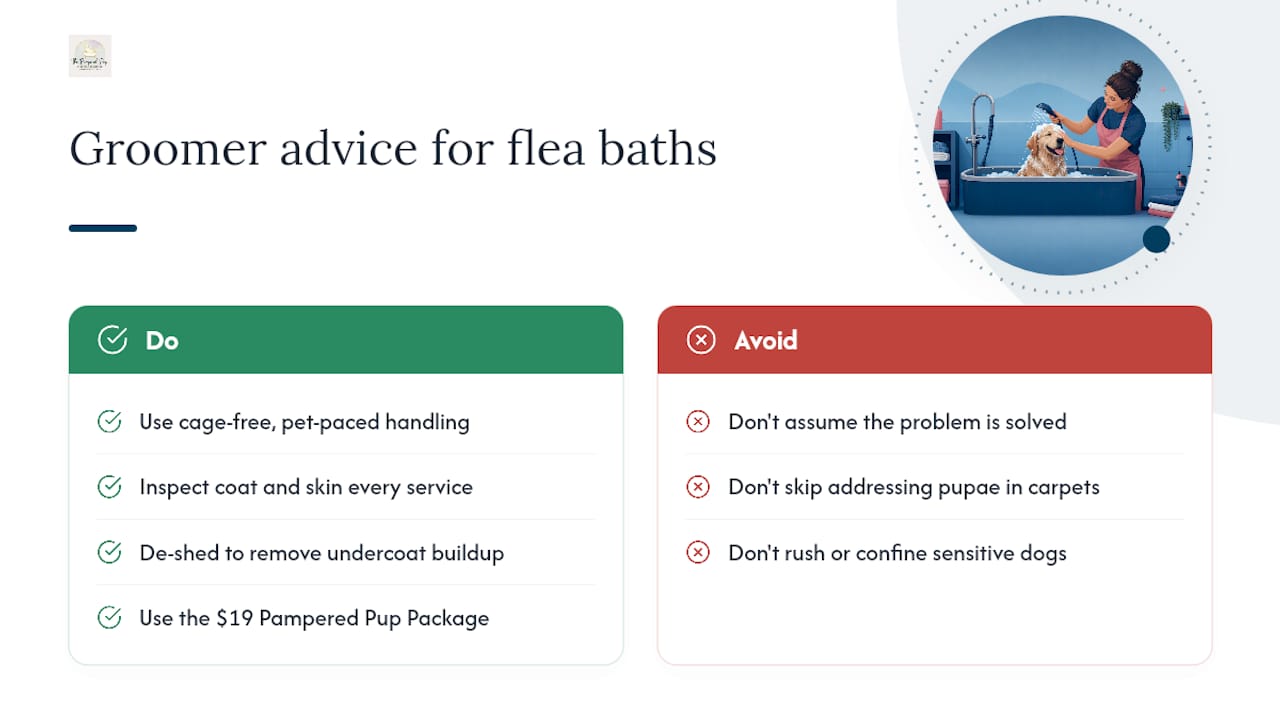
The most common thing pet parents miss is the gap between the bath and the follow-up. They bathe their dog, feel relieved when the fleas are gone, and assume the problem is solved. Three days later, the dog is scratching again — because the pupae in the carpet were never addressed.
What we do differently at The Pampered Pup is take our time. Our cage-free, pet-paced approach means a dog dealing with skin irritation from fleas is never rushed or confined. We work gently, let the dog set the pace, and pay close attention to the coat and skin during every service. A thorough grooming session is one of the best ways to catch a flea problem early, before it becomes an infestation.
Our full grooms, de-shedding treatments, and bath and brush services all include careful coat inspection. The $19 Pampered Pup Package — which includes a blueberry facial, tooth brushing, deep coat conditioner, nail grinding, and paw balm — is a wonderful way to soothe irritated skin after a flea episode and restore the coat’s natural condition.
Pro Tip: In Gulf Coast humidity, a dog’s coat stays damp longer after a bath, which can trap heat and irritate already-sensitive skin. A professional de-shedding treatment removes the undercoat buildup that traps moisture and makes flea combing more effective.
For puppies and senior dogs, we offer specialized gentle handling that keeps the experience calm and positive. A puppy’s first flea bath should never be stressful — it sets the tone for a lifetime of easy, cooperative grooms.
The part of flea control most people get wrong
The conventional advice — bathe the dog, apply a spot-on, done — misses the most important variable: timing. A flea bath without a coordinated home treatment plan is like mopping a floor while the tap is still running. You will feel progress, but the source is still active.
What the research actually supports is a layered, timed approach. The bath handles what is on the dog today. A rapid systemic like Capstar handles what jumps on tomorrow. An IGR in the home handles what is still developing in the carpet. And a monthly or 12-week isoxazoline handles what emerges from cocoons weeks from now.
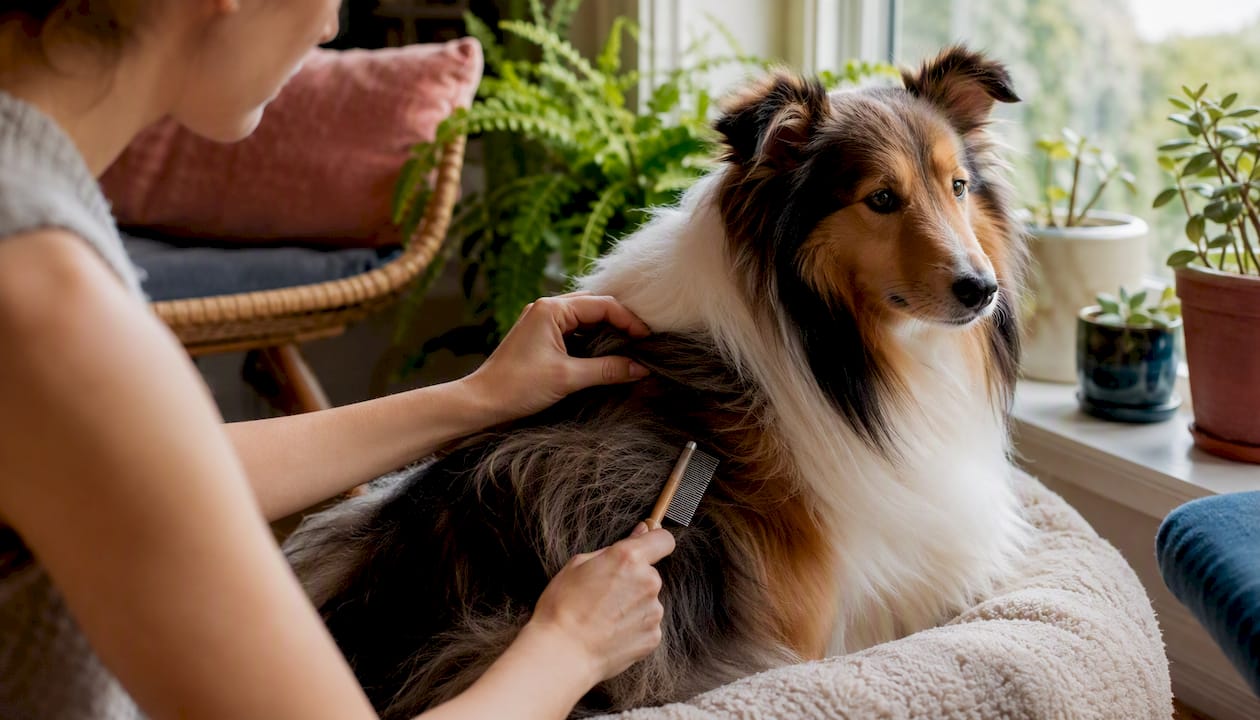
The other underrated step is the flea comb. Pet parents often skip it because it feels slow. But running a fine-toothed flea comb through the coat during the bath — while the product is still on — captures fleas that the shampoo stunned but did not kill, and removes flea dirt that would otherwise fall back into the environment. It is mechanical removal working alongside chemical control, and it costs nothing.
Gulf Coast pet parents specifically should plan for year-round prevention, not seasonal. Waiting until you see fleas to start a preventive means you are already behind. The most effective approach is continuous protection, adjusted by your vet for your dog’s age, health, and lifestyle.
Gentle, professional flea care at The Pampered Pup
After a flea episode, your dog’s skin and coat deserve some genuine care. At The Pampered Pup, our full grooming services are designed for exactly this kind of recovery — soothing irritated skin, removing flea dirt from the coat, and restoring softness and comfort.
We serve Mobile, Daphne, Spanish Fort, and Fairhope in a cage-free, open environment where your dog is never kenneled or rushed. Our de-shedding treatments are especially helpful after a flea infestation, removing the undercoat buildup that traps flea eggs and moisture. The $19 Pampered Pup Package includes a deep coat conditioner and paw balm that help repair skin stressed by scratching and repeated bathing. When your dog is ready for a calm, restorative experience, book an appointment online or call us at 251-776-2104.
Sources
The following authoritative references informed the veterinary recommendations, lifecycle details, and extension guidance in this article. For product selection and any dog with health concerns, consult your veterinarian directly.
- Flea Control in Dogs | VCA Animal Hospitals
- Biology and Control of Fleas | NC State Extension Publications
- Fleas: Life cycles | CDC
- Fleas in Dogs and Cats - Merck Veterinary Manual
- P2597 — Flea biology and control (Mississippi State Extension)
FAQ
What can I bathe my dog in to kill fleas?
A purpose-formulated flea shampoo containing pyrethrin or permethrin kills adult fleas on contact. Original blue Dawn dish soap is a safe emergency alternative that suffocates fleas, though it should not replace a proper flea treatment plan.
What kills fleas on dogs immediately?
Capstar (nitenpyram) begins killing adult fleas within 30 minutes of ingestion and is available without a prescription for dogs and puppies over four weeks and 2 lbs. A flea shampoo or Dawn dish soap applied during a bath also kills adult fleas on contact.
Will a Dawn dish soap bath kill fleas?
Yes — Dawn strips the waxy coating from a flea’s exoskeleton and kills adult fleas on contact during the bath. It provides no residual protection, so fleas can return as soon as the dog re-enters an infested area.
How effective is a flea bath for dogs overall?
A flea bath is effective at quickly reducing the adult flea load on your dog, but it does not affect eggs, larvae, or pupae in the environment, and it provides no lasting protection. Full flea control typically requires pairing a bath with a systemic preventive and coordinated home treatment over 2–3 months.
Recommended
- How Often Should You Bathe Your Dog? A Mobile Groomer’s Guide | AL
- Bath, Tidy-Up, or Full Groom? How to Know What Your Dog Needs | Mobile, AL
- Dog Grooming Services in Mobile, AL | The Pampered Pup
- Contact & Book a Dog Groomer in Mobile, AL | The Pampered Pup
Want a hand with this? We're a cage-free, pet-paced grooming salon on Oak Circle Drive East in Mobile, AL, with early drop-off from 7:30 AM Tuesday through Friday (8:30 AM Saturday). Book online or call 251-776-2104 and we'll build a plan around your dog.